The Best Weekly Strength Training Routinefor Muscle Growth, Fat Loss and Long-Term Health
Introduction
Many people spend years in the gym without following a structured strength training routine. They train hard, but their results eventually slow down because their weekly training plan lacks progression, recovery, and balance.
The best weekly strength training routine is one that allows you to build muscle, increase strength, improve body composition, and recover properly between sessions.
Whether your goal is muscle growth, fat loss, athletic performance, or healthy aging, a properly designed weekly training plan can help you achieve better results while reducing the risk of injury.
As a professional personal trainer in London with over 10 years of experience and more than 1,000 clients trained, I have found that consistency and intelligent programming outperform extreme training methods every time.
What Is Strength Training?
Strength training is a form of exercise that uses resistance to stimulate muscle adaptation, improve force production, and increase physical performance.
Resistance can come from:
- Free weights
- Machines
- Resistance bands
- Bodyweight exercises
- Functional equipment
Strength training affects much more than muscle size.
Research shows that regular resistance training can support:
- Increased muscle mass
- Higher bone density
- Improved insulin sensitivity
- Better posture
- Enhanced athletic performance
- Improved metabolic health
- Healthy aging
Why Most People Fail With Strength Training
Many gym users make one of these common mistakes:
Training Too Often
More workouts do not always mean better results.
Recovery is where adaptation occurs.
Training Without Progression
Using the same weights every week eventually leads to stagnation.
Ignoring Compound Movements
Compound exercises recruit the most muscle mass and create the largest training stimulus.
Poor Recovery Habits
Lack of sleep, inadequate nutrition, and excessive stress limit progress.
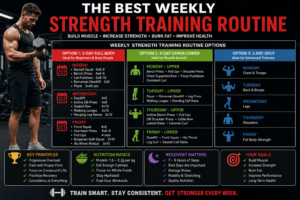
The Best Weekly Strength Training Routine
Option 1: 3-Day Full Body Routine
Ideal for:
- Beginners
- Busy professionals
- Fat loss goals
- General health
Monday
- Barbell Squat – 4 sets × 6-8 reps
- Bench Press – 4 sets × 6-8 reps
- Lat Pulldown – 3 sets × 8-12 reps
- Romanian Deadlift – 3 sets × 8 reps
- Plank – 3 sets × 45 seconds
Wednesday
- Deadlift – 4 sets × 5 reps
- Incline Dumbbell Press – 4 sets × 8 reps
- Seated Row – 4 sets × 10 reps
- Walking Lunges – 3 sets × 12 reps
- Hanging Leg Raises – 3 sets × 12 reps
Friday
- Front Squat – 4 sets × 6 reps
- Overhead Press – 4 sets × 6-8 reps
- Pull Ups – 4 sets
- Bulgarian Split Squat – 3 sets × 10 reps
- Ab Wheel Rollout – 3 sets × 10 reps
Option 2: 4-Day Upper Lower Split
Ideal for:
- Intermediate lifters
- Muscle growth
- Strength development
Monday – Upper Body
- Bench Press
- Pull Ups
- Shoulder Press
- Chest Supported Row
- Tricep Pushdown
- Dumbbell Curl
Tuesday – Lower Body
- Squat
- Romanian Deadlift
- Leg Press
- Walking Lunges
- Standing Calf Raise
Thursday – Upper Body
- Incline Bench Press
- Pull Ups
- Dumbbell Shoulder Press
- Cable Row
- Lateral Raise
- Hammer Curl
Friday – Lower Body
- Deadlift
- Front Squat
- Hip Thrust
- Leg Curl
- Seated Calf Raise
Option 3: 5-Day Strength and Hypertrophy Program
Ideal for:
- Advanced trainees
- Athletes
- Body composition goals
Monday – Chest and Triceps
Tuesday – Back and Biceps
Wednesday – Legs
Thursday – Shoulders
Friday – Full Body Strength
This structure allows greater training volume while still providing recovery.
The Most Important Strength Training Principles
Progressive Overload
Gradually increase:
- Weight
- Repetitions
- Sets
- Training density
Small improvements performed consistently create significant long-term results.
Recovery
Muscle growth occurs during recovery, not during training.
Focus on:
- 7–9 hours of sleep
- High-quality nutrition
- Hydration
- Stress management
Exercise Technique
Proper form should always take priority over heavier weights.
Good technique:
- Improves muscle activation
- Reduces injury risk
- Creates more consistent progress
Best Exercises for Strength Development
Lower Body
- Squat
- Front Squat
- Deadlift
- Romanian Deadlift
- Walking Lunges
- Split Squats
Upper Body Push
- Bench Press
- Incline Press
- Overhead Press
- Dumbbell Press
Upper Body Pull
- Pull Ups
- Chin Ups
- Barbell Row
- Cable Row
- Lat Pulldown
Nutrition for Strength Training
Strength training performance depends heavily on nutrition.
Focus on:
Protein
Aim for:
1.6–2.2 grams per kilogram of bodyweight daily.
Carbohydrates
Support training performance and recovery.
Healthy Fats
Essential for hormone production and recovery.
Hydration
Even mild dehydration can negatively impact performance.
Recovery Tools That Can Support Strength Training
Many athletes incorporate recovery technologies such as:
- Red Light Therapy
- Compression Boots
- Massage Therapy
- Mobility Training
- Sauna
- Cold Water Immersion
These tools may help support recovery between sessions and improve training consistency.
Frequently Asked Questions
How many days per week should I strength train?
Most people achieve excellent results training 3–5 times per week.
Is strength training good for fat loss?
Yes. Strength training helps preserve muscle mass while increasing energy expenditure.
Should beginners lift heavy weights?
Beginners should focus on learning technique before maximizing load.
What is the best strength training split?
A full body routine for beginners and an upper/lower split for intermediates are highly effective.
How long should a strength workout last?
Most productive workouts last between 45 and 75 minutes.
Can strength training slow aging?
Research suggests resistance training supports muscle mass, bone density, metabolic health and physical function as we age.
Is cardio necessary alongside strength training?
Moderate cardiovascular exercise can complement strength training and support overall health.
Final Thoughts
The best weekly strength training routine is not the most complicated one.
It is the routine you can follow consistently while progressively becoming stronger, building muscle, improving body composition and maintaining long-term health.
Whether you train three, four or five days per week, focus on progressive overload, quality movement, proper recovery and long-term consistency.
Results come from years of smart training, not a few weeks of extreme effort.