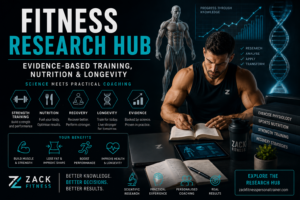
Evidence-Based Fitness, Strength Training, Nutrition, Recovery & Longevity
Welcome to the Zack Fitness Research Hub
The fitness industry has never had more information available.
Every day thousands of new videos, articles and social media posts promise the fastest way to lose fat, build muscle or become healthier.
Unfortunately, more information doesn’t always mean better information.
One study says carbohydrates are bad.
Another says they are essential.
One influencer recommends training every day.
Another recommends only three sessions per week.
This creates confusion.
The purpose of the Zack Fitness Research Hub is to simplify the science behind fitness and explain how evidence can be applied in real life.
My coaching philosophy combines scientific research with years of practical coaching experience.
Research provides direction.
Experience provides application.
Together they create better results.
Why Evidence-Based Training Matters
Good coaching should never rely purely on opinions.
It should combine three important elements:
✔ Scientific evidence
✔ Practical coaching experience
✔ Individual client needs
Science helps us understand how the body responds to training.
Experience helps determine how these principles work in the real world.
Every client is different.
Research provides the foundation.
Coaching provides the personalisation.
The Zack Fitness Research Philosophy
I believe that no single study should completely change the way people train.
Instead, I look for patterns across multiple high-quality studies and compare those findings with practical coaching experience.
Good coaching asks questions such as:
• What does the evidence suggest?
• Is the evidence strong?
• Can it realistically be applied?
• Does it fit the client’s goals?
• Is it sustainable?
The objective is not to chase every new trend.
The objective is to make intelligent decisions supported by both science and real-world experience.
My Areas of Research
The Zack Fitness Research Hub focuses on the subjects that have the greatest impact on long-term health and performance.
These include:
• Strength Training
• Muscle Hypertrophy
• Fat Loss
• Body Recomposition
• Recovery
• Sleep
• Nutrition
• Mobility
• Longevity
• Healthy Ageing
• Sports Performance
• Injury Prevention
• Exercise Technique
• Supplements
• Biohacking
• Behaviour Change
• Exercise Psychology
Each topic is continually updated as new evidence becomes available.
Science Should Be Practical
Scientific research is valuable.
However, scientific papers are often difficult to understand.
Many studies use technical language that makes them inaccessible for most people.
One of my goals is translating complex research into practical advice.
Instead of overwhelming clients with scientific terminology, I explain:
What does this mean?
Why does it matter?
How can you apply it?
This allows clients to make better decisions without needing a degree in exercise science.
Research Alone Is Not Enough
Scientific evidence is incredibly valuable.
However, evidence should never be viewed in isolation.
A programme that works perfectly inside a controlled laboratory may not always work for someone balancing:
• A demanding career
• Family responsibilities
• Business travel
• Limited sleep
• High stress
The best coaching combines research with practical application.
That is the philosophy behind the Zack Fitness Method.
Continuous Learning
Fitness is constantly evolving.
New research is published every week.
Rather than believing I already know everything, I believe in continuous learning.
Every year I continue studying topics including:
• Strength Training
• Hypertrophy
• Nutrition
• Recovery
• Longevity
• Exercise Science
• Behaviour Change
• Performance
The more we learn, the better decisions we can make for our clients.
Critical Thinking Over Trends
The fitness industry changes rapidly.
One month a supplement is considered revolutionary.
The next month it disappears.
The same happens with training methods, diets and recovery techniques.
Instead of following trends, I ask three simple questions:
Is there good evidence?
Is it safe?
Will it genuinely help the client?
If the answer is yes, it deserves consideration.
If not, it is simply another trend.
My Promise
The Zack Fitness Research Hub is built on one principle:
Provide honest, practical and evidence-informed information that helps people become healthier, stronger and more confident.
If research changes, my recommendations may also evolve.
Good coaches are willing to learn.
Good coaches are willing to improve.
That mindset allows clients to benefit from both experience and the latest evidence.
What You Will Find Here
Over time this Research Hub will include detailed guides covering:
✔ Strength Training
✔ Muscle Growth
✔ Fat Loss
✔ Recovery
✔ Nutrition
✔ Sleep
✔ Supplements
✔ Mobility
✔ Healthy Ageing
✔ Longevity
✔ Exercise Technique
✔ Injury Prevention
✔ Body Transformation
✔ Sports Performance
✔ Biohacking
✔ AI and Fitness
Each guide is designed to answer the most common questions people ask while providing practical recommendations that can be applied immediately.
Key Takeaway
The purpose of the Zack Fitness Research Hub is not simply to summarise studies.
Its purpose is to bridge the gap between science and real-world coaching.
The combination of evidence, experience and personalised programming forms the foundation of everything I do as a personal trainer.
Because better knowledge leads to better decisions.
And better decisions lead to better results.
Strength Training Research
The Science Behind Building Strength, Muscle and Long-Term Health
Strength training is one of the most researched forms of physical activity.
Over the past several decades, thousands of scientific studies have investigated how resistance training influences muscle growth, strength development, metabolic health, bone density, cardiovascular health and healthy ageing.
Although training methods continue to evolve, several principles have consistently been supported by high-quality research.
The purpose of this section is to explain those principles in a practical way and show how they are applied within the Zack Fitness Method.
Rather than chasing trends or copying social media workouts, I believe successful coaching should be built on proven fundamentals that can be adapted to each individual.
Why Strength Training Matters
Many people begin resistance training because they want to improve how they look.
While improving body composition is an excellent goal, the benefits extend far beyond appearance.
Current evidence suggests that regular strength training can contribute to:
• Increased muscle mass
• Improved strength
• Better functional capacity
• Higher bone mineral density
• Improved insulin sensitivity
• Healthier body composition
• Better posture and movement
• Reduced risk of falls in older adults
• Greater confidence
• Improved quality of life
Strength training is not only for athletes.
It is one of the most valuable forms of exercise for almost every adult.
Progressive Overload
One of the most important concepts in exercise science is progressive overload.
Your body adapts to the demands placed upon it.
If training never changes, adaptation eventually slows.
Progressive overload simply means gradually increasing the challenge placed on the body over time.
Progress can be achieved by:
• Increasing resistance
• Performing more repetitions
• Adding an additional set
• Improving exercise technique
• Increasing range of motion
• Improving control
• Increasing training frequency where appropriate
• Reducing unnecessary assistance
The goal is not to increase weight every session.
The goal is continuous improvement.
Small improvements accumulated over months often produce remarkable long-term results.
Mechanical Tension
Current research suggests that mechanical tension is one of the primary drivers of muscle growth.
Mechanical tension occurs when muscles generate force while working against resistance.
The quality of the stimulus matters more than simply moving heavy weights.
For this reason I encourage clients to focus on:
✔ Controlled repetitions
✔ Full range of motion where appropriate
✔ Stable body positioning
✔ Consistent technique
✔ Intentional movement
Every repetition should challenge the target muscles rather than relying on momentum.
Training Frequency
One of the most common questions clients ask is:
“How many days per week should I train?”
There is no universal answer.
The ideal frequency depends on factors such as:
• Training experience
• Recovery capacity
• Lifestyle
• Goals
• Available time
• Total weekly training volume
For many people, training two to four times per week provides an excellent balance between stimulus and recovery.
Advanced athletes may require different programming depending on their objectives.
Consistency is generally more important than chasing the highest possible frequency.
Training Volume
Training volume refers to the total amount of work performed.
Research suggests that performing an appropriate amount of weekly volume is important for strength and hypertrophy.
However, more is not always better.
Excessive volume without adequate recovery may reduce performance and increase fatigue.
Too little volume may not provide enough stimulus for adaptation.
Finding the appropriate balance is one of the most important responsibilities of a coach.
That balance differs between individuals.
Intensity
Intensity describes how challenging a set is relative to your current ability.
Training too lightly may limit progress.
Training maximally every session may compromise recovery.
Within the Zack Fitness Method, intensity is adjusted according to:
• Training experience
• Exercise selection
• Recovery
• Programme phase
• Individual goals
Not every exercise needs to be performed with maximum effort.
Intelligent programming balances challenge with sustainability.
Compound vs Isolation Exercises
Both compound and isolation exercises have valuable roles within a well-designed programme.
Compound exercises involve multiple joints and muscle groups.
Examples include:
• Squats
• Romanian Deadlifts
• Bench Press
• Rows
• Pull-Ups
Isolation exercises focus more directly on a single muscle group.
Examples include:
• Biceps Curls
• Leg Extensions
• Leg Curls
• Lateral Raises
• Triceps Pushdowns
Rather than choosing one over the other, I combine both depending on the client’s goals, experience and needs.
Free Weights vs Machines
One debate that continues in the fitness industry is whether free weights or machines are superior.
In reality, both have advantages.
Free weights may help develop coordination and stabilisation.
Machines can provide greater stability and allow focused loading of specific muscle groups.
The best choice depends on:
• The exercise
• The client
• The goal
• Technical ability
• Previous injuries
I use whichever tool best supports the desired outcome.
Equipment should serve the programme—not define it.
Quality Repetitions
One perfect repetition is more valuable than several poorly executed repetitions.
Each repetition should demonstrate:
• Control
• Stability
• Consistent technique
• Appropriate range of motion
• Proper breathing
• Intentional muscle activation
The objective is not simply completing the set.
The objective is creating an effective training stimulus.
Common Strength Training Myths
Over the years many myths have become widely accepted despite limited evidence.
Examples include:
❌ More pain always means more progress.
❌ Longer workouts are always better.
❌ Heavier weights are always superior.
❌ Machines are ineffective.
❌ Cardio destroys muscle.
❌ Women become excessively muscular from lifting weights.
Good coaching requires separating evidence from popular opinion.
Strength Training Is a Long-Term Investment
Strength is not built in a week.
Muscle is not built in a month.
The greatest results come from years of intelligent training.
The objective is to build habits that remain sustainable throughout life.
When strength training becomes part of your lifestyle, the benefits continue far beyond improvements in appearance.
Key Takeaway
Strength training is one of the most powerful tools available for improving health, performance and quality of life.
Research provides valuable guidance, but successful coaching comes from applying those principles intelligently to each individual.
Within the Zack Fitness Method, strength training is never random.
It is structured, progressive, personalised and designed to deliver sustainable long-term results.
Muscle Hypertrophy Research
Understanding the Science of Building Muscle
Muscle hypertrophy is the process of increasing the size of skeletal muscle fibres through consistent resistance training and proper recovery.
Although building muscle may appear simple from the outside, it is the result of complex physiological adaptations involving mechanical loading, muscle protein synthesis, nutrition, recovery and progressive training.
The good news is that current scientific evidence provides clear guidance on many of the principles that support muscle growth.
The Zack Fitness Method applies these principles while adapting them to each individual’s goals, experience and recovery capacity.
Building muscle is not about finding one perfect exercise or one secret technique.
It is about consistently applying proven fundamentals over time.
What Is Muscle Hypertrophy?
Muscle hypertrophy refers to the increase in the size of muscle fibres following repeated exposure to resistance training.
When muscles are challenged appropriately, the body responds by repairing and strengthening those tissues.
Over time this leads to:
• Increased muscle size
• Greater strength
• Improved physical performance
• Better body composition
• Enhanced metabolic health
Muscle growth does not happen during the workout itself.
Training provides the stimulus.
Recovery allows adaptation.
Muscle Protein Synthesis
One of the key biological processes involved in muscle growth is muscle protein synthesis (MPS).
After resistance training, the body increases the rate at which it repairs and builds muscle proteins.
To support this process, adequate nutrition—particularly sufficient protein intake—and recovery are essential.
Training creates the signal.
Nutrition provides the building blocks.
Recovery allows adaptation.
Without all three, progress is limited.
Mechanical Tension – The Primary Driver
Current evidence suggests that mechanical tension is one of the most important factors contributing to hypertrophy.
Mechanical tension is created when muscles produce force while working against resistance.
High-quality mechanical tension requires:
✔ Stable technique
✔ Controlled movement
✔ Appropriate resistance
✔ Full range of motion where appropriate
✔ Consistent progression
The objective is not simply moving heavy weights.
The objective is placing effective tension on the target muscle.
Training Close to Failure
One question often discussed in exercise science is whether every set should be taken to complete muscular failure.
Current evidence suggests that training close to failure can provide an effective stimulus for muscle growth, but not every exercise or every set needs to reach absolute failure.
Constantly pushing every set to failure may increase fatigue and reduce recovery for some individuals.
Within the Zack Fitness Method, effort is managed according to:
• Exercise selection
• Training phase
• Experience level
• Recovery capacity
The aim is to stimulate adaptation while maintaining high training quality across the programme.
Repetition Ranges
Many people ask:
“What is the best number of repetitions for muscle growth?”
Research indicates that hypertrophy can be achieved across a wide range of repetition schemes when sets are performed with sufficient effort and overall training volume is appropriate.
Different repetition ranges can have different advantages.
Lower repetitions may emphasise strength development.
Moderate repetitions are commonly used for hypertrophy.
Higher repetitions can also stimulate muscle growth when performed effectively.
Rather than searching for one perfect number, I vary repetition ranges according to the objective of the exercise and the individual.
Tempo
Tempo describes the speed at which each repetition is performed.
Many people rush through exercises without controlling the movement.
Slowing down certain phases of an exercise can improve:
• Technique
• Stability
• Muscle awareness
• Exercise quality
Rather than chasing speed, I encourage controlled movement with purpose.
Every repetition should be deliberate.
Range of Motion
Research generally supports using an appropriate range of motion for most resistance training exercises.
A full, controlled range of motion often allows muscles to work through a greater portion of their functional capacity.
However, exercise execution should always respect the individual’s mobility, comfort and any relevant medical considerations.
The objective is effective movement—not forcing positions that are uncomfortable or unsafe.
Rest Periods
Rest between sets influences training quality.
Longer rest periods may help maintain performance during heavier compound exercises.
Moderate rest periods are often suitable for hypertrophy-focused training.
The appropriate rest depends on:
• Exercise type
• Training goal
• Fitness level
• Programme design
Rest should support quality performance rather than simply shorten the workout.
Exercise Selection for Hypertrophy
No single exercise builds every muscle equally.
Effective programme design requires selecting exercises that:
✔ Match the client’s anatomy
✔ Can be performed safely
✔ Allow progressive overload
✔ Target the intended muscles effectively
✔ Fit within the overall programme
Sometimes machines provide excellent muscle isolation.
Sometimes free weights provide greater versatility.
The best programmes use both when appropriate.
Nutrition for Muscle Growth
Training alone cannot maximise hypertrophy.
Nutrition provides the raw materials required for adaptation.
A muscle-building nutrition strategy generally includes:
• Sufficient protein intake
• Adequate total energy intake
• Balanced carbohydrate intake
• Healthy fats
• Hydration
• Consistent eating habits
Rather than relying on supplements alone, I encourage clients to build strong nutritional foundations first.
Recovery and Muscle Growth
Recovery is often underestimated.
Without sufficient recovery:
• Muscle protein synthesis may be compromised.
• Training quality may decline.
• Fatigue accumulates.
• Injury risk may increase.
Key recovery priorities include:
✔ Sleep
✔ Nutrition
✔ Hydration
✔ Stress management
✔ Intelligent programming
Recovery allows the body to adapt to the training stimulus.
Common Muscle Building Myths
Many misconceptions continue to circulate within the fitness industry.
Examples include:
❌ You must train every muscle every day.
❌ More exercises always produce more muscle.
❌ Muscle soreness means the workout was successful.
❌ You need to change your programme every week.
❌ Supplements are more important than nutrition.
❌ Heavy weights are the only way to build muscle.
Successful hypertrophy depends on consistency rather than constantly chasing new trends.
Building Muscle Takes Time
One of the biggest mistakes beginners make is expecting dramatic changes within a few weeks.
Muscle growth is a gradual process.
Long-term success comes from:
• Consistent training
• Progressive overload
• Good nutrition
• Recovery
• Patience
Small improvements repeated over months and years produce significant transformations.
The Zack Fitness Approach to Hypertrophy
Within the Zack Fitness Method, hypertrophy is never approached through random workouts.
Each programme is designed around:
✔ Individual goals
✔ Recovery capacity
✔ Exercise quality
✔ Progressive programming
✔ Long-term sustainability
The objective is not only to build more muscle.
It is to build muscle while maintaining health, movement quality and long-term performance.
Key Takeaway
Muscle growth is not the result of one exercise, one supplement or one perfect workout.
It is the result of applying proven principles consistently over time.
Current scientific evidence provides a strong foundation.
Personalised coaching ensures those principles are adapted to the individual.
That combination is at the heart of the Zack Fitness Method.
Fat Loss Research
The Science Behind Sustainable Fat Loss
Fat loss is one of the most misunderstood topics in the fitness industry.
Every year new diets, supplements and training methods promise rapid transformations.
Some produce short-term changes.
Very few create long-term success.
The Zack Fitness Research Hub focuses on sustainable fat loss by combining current scientific evidence with practical coaching experience.
The objective is not simply helping someone lose weight.
The objective is helping them maintain a healthier body composition for life.
Understanding Energy Balance
Body weight is influenced by energy balance.
Simply put:
When energy intake consistently exceeds energy expenditure, body weight tends to increase.
When energy expenditure consistently exceeds energy intake, body fat is generally reduced over time.
Although this principle is well supported, successful fat loss is far more complex than calories alone.
Factors such as food quality, protein intake, sleep, stress, physical activity and training all influence long-term success.
The goal is not just to create a calorie deficit.
The goal is to create one that is realistic, healthy and sustainable.
Calories Matter—But They Are Not Everything
Many people believe that only calories matter.
While total energy intake is important, the quality of those calories also affects:
• Hunger
• Energy levels
• Recovery
• Training performance
• Nutrient intake
• Long-term adherence
A diet made primarily of highly processed foods may technically create a calorie deficit, but it is unlikely to support optimal health or athletic performance.
For this reason I encourage clients to prioritise whole, minimally processed foods whenever possible.
Protein and Fat Loss
Protein plays an important role during weight loss.
Research suggests that adequate protein intake can help:
• Preserve lean muscle mass
• Increase satiety
• Support recovery
• Improve body composition
Maintaining muscle while reducing body fat is one of the primary objectives of the Zack Fitness Method.
Fat loss should improve your physique—not reduce your strength.
Why Strength Training Is Essential
Many people still believe cardio is the only effective way to lose weight.
Current evidence shows that resistance training should also be a key part of most fat-loss programmes.
Strength training helps:
✔ Maintain muscle mass
✔ Improve strength
✔ Increase training performance
✔ Support long-term metabolic health
✔ Improve body composition
The goal is not simply becoming lighter.
The goal is becoming leaner, stronger and healthier.
Cardio Has an Important Role
Cardiovascular training provides many health benefits.
Depending on the individual’s goals, cardio may help improve:
• Heart health
• Aerobic fitness
• Daily energy expenditure
• Recovery capacity
• Endurance
Rather than prescribing excessive cardio for everyone, I select the amount based on:
• Goals
• Recovery
• Lifestyle
• Training schedule
The best programme balances resistance training and cardiovascular exercise appropriately.
NEAT – The Hidden Fat Loss Tool
One of the most overlooked factors in fat loss is Non-Exercise Activity Thermogenesis (NEAT).
NEAT includes everyday movement outside structured exercise.
Examples include:
• Walking
• Standing
• Climbing stairs
• Housework
• Gardening
• Carrying shopping
• General daily movement
Increasing daily activity often contributes significantly to overall energy expenditure without requiring additional gym sessions.
Sometimes walking more provides greater long-term benefits than performing excessive cardio.
Sleep and Weight Management
Sleep influences many aspects of health.
Poor sleep may affect:
• Appetite regulation
• Food choices
• Energy
• Recovery
• Training quality
Improving sleep habits often makes healthy eating and consistent exercise easier to maintain.
Sleep is therefore considered one of the foundations of successful body transformation.
Stress and Fat Loss
Modern life creates significant stress for many people.
Business deadlines.
Family responsibilities.
Travel.
Lack of recovery.
High stress can make healthy habits more difficult to maintain.
For this reason I encourage clients to build programmes that fit their lives rather than trying to follow unrealistic routines.
Sustainable habits always outperform extreme short-term plans.
Body Recomposition
Many people ask whether it is possible to lose fat while building muscle.
Body recomposition can occur under the right circumstances, particularly in:
• Beginners
• Individuals returning after a break
• People improving their nutrition
• Clients following well-designed resistance training programmes
The emphasis should remain on consistent progress rather than chasing unrealistic expectations.
Common Fat Loss Myths
The fitness industry contains many myths that continue to circulate despite limited evidence.
Examples include:
❌ Carbohydrates automatically make you gain fat.
❌ Eating after 6 pm causes weight gain.
❌ Fat-burning supplements replace proper nutrition.
❌ Sweating more means you lose more body fat.
❌ Spot reduction removes fat from specific body parts.
❌ You must eliminate all treats to lose weight.
The most effective approach is usually the one you can maintain consistently.
Long-Term Weight Maintenance
Losing weight is only one part of the journey.
Keeping it off is often the greater challenge.
Successful long-term weight maintenance usually involves:
✔ Regular physical activity
✔ Strength training
✔ Consistent eating habits
✔ Adequate sleep
✔ Ongoing self-monitoring
✔ Flexible nutrition
✔ Sustainable routines
The objective is creating habits that become part of everyday life.
My Fat Loss Philosophy
I do not believe in punishment.
I do not believe in starvation.
I do not believe in unsustainable restriction.
I believe in education.
Consistency.
Personalisation.
Progressive improvement.
Healthy habits.
The Zack Fitness Method helps clients build a lifestyle that supports long-term health rather than temporary transformation.
Key Takeaway
Fat loss is not achieved through one diet, one workout or one supplement.
It is the result of consistently applying evidence-informed principles over time.
When nutrition, strength training, daily movement, recovery and sustainable habits work together, long-term success becomes far more achievable.
The goal is not simply losing weight.
The goal is building a healthier, stronger and more confident version of yourself.
Recovery Research
The Science of Recovery, Adaptation and Long-Term Performance
Many people believe that progress is created during the workout.
In reality, exercise provides the stimulus.
Recovery allows the body to adapt.
Every resistance training session creates temporary stress on muscles, connective tissues and the nervous system. The body responds to that stress by repairing and adapting, provided it has enough time and resources to recover.
Without adequate recovery, performance may decline, fatigue can accumulate and long-term progress often slows.
For this reason, recovery is not separate from training.
Recovery is part of training.
Within the Zack Fitness Method, recovery is planned just as carefully as exercise selection.
What Is Recovery?
Recovery is the process through which the body returns to a state where it can perform effectively again.
It involves multiple systems working together, including:
• Muscular recovery
• Nervous system recovery
• Connective tissue adaptation
• Energy restoration
• Hormonal regulation
• Mental recovery
Successful recovery does not simply reduce soreness.
It prepares the body for the next productive training session.
Why Recovery Matters
Current evidence suggests that appropriate recovery supports:
• Better training quality
• Improved strength adaptations
• Muscle growth
• Better movement quality
• Reduced fatigue
• Improved consistency
• Better overall wellbeing
The goal is not simply to recover faster.
The goal is to recover well enough to continue progressing safely.
Sleep – The Foundation of Recovery
Sleep remains one of the most important recovery tools available.
During sleep, the body supports many processes involved in repair and adaptation.
High-quality sleep contributes to:
• Muscle recovery
• Memory and learning
• Hormonal regulation
• Nervous system recovery
• Immune function
• Mood and mental performance
Rather than searching for expensive recovery tools first, I encourage clients to build strong sleep habits.
Simple habits may include:
✔ Going to bed at a consistent time
✔ Limiting bright screens before sleep
✔ Keeping the bedroom cool, dark and quiet
✔ Managing caffeine intake later in the day
✔ Creating a relaxing bedtime routine
Good recovery often starts the night before your next workout.
Muscle Recovery
Muscles adapt after resistance training by repairing damaged tissue and becoming better prepared for future training.
Recovery does not mean avoiding activity completely.
Instead, recovery should provide the body with the opportunity to adapt while maintaining overall movement.
Appropriate nutrition, hydration, sleep and intelligent programming all contribute to this process.
Delayed Onset Muscle Soreness (DOMS)
Many people associate soreness with progress.
However, muscle soreness is not a reliable measure of workout quality.
DOMS usually appears between 24 and 72 hours after unfamiliar or demanding exercise.
While some soreness can be normal, excessive soreness may reduce training quality and daily function.
The objective is not to feel sore after every session.
The objective is to make consistent progress.
Active Recovery
Recovery does not always require complete rest.
Low-intensity movement can often support recovery while maintaining circulation and mobility.
Examples include:
• Walking
• Easy cycling
• Swimming
• Mobility exercises
• Stretching
• Light yoga
The most appropriate strategy depends on the individual, the previous training session and overall recovery status.
Mobility and Recovery
Good mobility helps maintain healthy movement patterns.
Mobility work may contribute to:
• Improved exercise technique
• Better movement quality
• Increased comfort during training
• Better joint function
Rather than chasing extreme flexibility, I encourage mobility work that supports daily movement and exercise performance.
Hydration
Water is involved in countless physiological processes.
Adequate hydration supports:
• Exercise performance
• Thermoregulation
• Recovery
• Cardiovascular function
• General health
Small reductions in hydration status may influence performance, particularly during longer or more demanding sessions.
Consistent hydration should therefore be part of every training programme.
Nutrition and Recovery
Recovery nutrition helps provide the resources needed for adaptation.
General priorities include:
✔ Adequate protein
✔ Sufficient energy intake
✔ Carbohydrates appropriate to activity level
✔ Healthy dietary fats
✔ Fruits and vegetables
✔ Hydration
The objective is not perfection.
The objective is consistency.
Stress Management
Recovery is influenced not only by training but also by life outside the gym.
Work pressure.
Business travel.
Poor sleep.
Family responsibilities.
Financial stress.
These factors influence how well the body responds to exercise.
For this reason, programmes should reflect the client’s recovery capacity rather than simply increasing workload every week.
Deload Weeks
Training continuously at high intensity is not always the fastest path to long-term progress.
Strategically reducing training volume or intensity for a short period may help:
• Reduce accumulated fatigue
• Improve motivation
• Support continued progression
• Maintain movement quality
Deloads are not signs of weakness.
They are part of intelligent programming.
Recovery Technologies
Modern recovery tools have become increasingly popular.
Examples include:
• Compression boots
• Massage devices
• Infrared sauna
• Cold water immersion
• Red light therapy
• Hyperbaric oxygen therapy
• Percussive massage
Some of these modalities show promising evidence for specific situations, while others require further research before firm conclusions can be drawn.
Within the Zack Fitness Method, technology is viewed as an addition to—not a replacement for—the fundamentals of sleep, nutrition and appropriate training.
Monitoring Recovery
One of the best ways to improve long-term progress is paying attention to recovery.
Useful indicators include:
• Energy levels
• Motivation to train
• Training performance
• Sleep quality
• Muscle soreness
• Daily stress
• Overall wellbeing
These observations help guide training decisions more effectively than relying on motivation alone.
Common Recovery Myths
Several myths continue to circulate within the fitness industry.
Examples include:
❌ More soreness always means better progress.
❌ Rest days are wasted days.
❌ Sleeping less allows more time to train.
❌ Recovery is only important for elite athletes.
❌ Expensive recovery devices replace healthy habits.
Recovery supports every stage of progress, regardless of experience level.
The Zack Fitness Recovery Philosophy
Recovery should never be treated as an afterthought.
My priorities are simple:
- Sleep
- Nutrition
- Hydration
- Intelligent programming
- Stress management
- Mobility
- Appropriate recovery strategies
Only after these foundations are established do advanced recovery technologies become worth considering.
Master the basics first.
Optimise the details second.
Key Takeaway
Recovery is not the opposite of training.
Recovery is what allows training to produce results.
The body becomes stronger, fitter and more resilient by balancing appropriate exercise with appropriate recovery.
Within the Zack Fitness Method, recovery is considered one of the most valuable investments a client can make in their long-term health and performance.
Nutrition Research
The Science of Nutrition for Performance, Body Composition and Long-Term Health
Nutrition is one of the most powerful tools available for improving health, physical performance and body composition.
Yet it is also one of the most misunderstood.
Every year new diets claim to be the ultimate solution.
Low carbohydrate.
Low fat.
Intermittent fasting.
Detoxes.
Juice cleanses.
Carnivore.
Keto.
Vegan.
Paleo.
Mediterranean.
The reality is far more nuanced.
Current scientific evidence suggests that there is no single eating pattern that is optimal for everyone.
The best nutrition strategy is the one that provides adequate nutrients, supports your goals and is sustainable within your lifestyle.
Within the Zack Fitness Method, nutrition is never about restriction.
It is about fuelling the body to perform, recover and remain healthy for years to come.
Nutrition Is More Than Calories
Calories matter.
However, nutrition involves much more than energy intake alone.
Food provides:
• Protein
• Carbohydrates
• Healthy fats
• Vitamins
• Minerals
• Fibre
• Water
• Phytochemicals
These nutrients support virtually every process within the body.
Training creates the demand.
Nutrition provides the resources.
Recovery allows adaptation.
All three work together.
Protein – The Foundation of Recovery and Muscle Growth
Protein is one of the most important nutrients for physically active individuals.
Current evidence suggests that consuming adequate protein supports:
✔ Muscle protein synthesis
✔ Recovery after resistance training
✔ Maintenance of lean muscle during weight loss
✔ Healthy ageing
✔ Satiety
Rather than chasing extremely high intakes, I encourage clients to consume sufficient protein distributed across the day according to their needs.
Protein-rich foods include:
• Chicken
• Turkey
• Lean beef
• Fish
• Eggs
• Greek yoghurt
• Cottage cheese
• Tofu
• Tempeh
• Legumes
Supplements can be useful, but whole foods remain the foundation of good nutrition.
Carbohydrates – Your Primary Training Fuel
Carbohydrates are often misunderstood.
Current research does not support the idea that carbohydrates are inherently unhealthy.
Instead, carbohydrates provide an important source of energy, particularly for moderate- to high-intensity exercise.
Appropriate carbohydrate intake can support:
• Training performance
• Recovery
• Muscle glycogen replenishment
• High-quality workouts
Rather than eliminating carbohydrates, I encourage clients to choose high-quality sources that fit their goals.
Examples include:
• Oats
• Rice
• Potatoes
• Sweet potatoes
• Wholegrain bread
• Fruit
• Vegetables
• Beans
The amount required depends on activity level, goals and personal preference.
Healthy Dietary Fats
Dietary fat is essential for normal body function.
Healthy fats contribute to:
• Hormone production
• Cell membrane function
• Brain health
• Absorption of fat-soluble vitamins
• Overall health
Examples of nutritious fat sources include:
• Olive oil
• Nuts
• Seeds
• Avocados
• Oily fish
• Nut butters
Rather than avoiding fats completely, focus on choosing predominantly unsaturated fat sources while maintaining appropriate portions.
Fibre – The Forgotten Nutrient
Fibre plays a major role in digestive health and overall wellbeing.
Adequate fibre intake supports:
• Digestive health
• Blood sugar regulation
• Cholesterol management
• Satiety
• A healthy gut microbiome
Foods naturally rich in fibre include:
• Vegetables
• Fruit
• Beans
• Lentils
• Whole grains
• Oats
• Seeds
• Nuts
Increasing fibre intake gradually while maintaining hydration is often the most comfortable approach.
Micronutrients Matter
Muscle is not built by protein alone.
The body also depends on vitamins and minerals that support countless biological processes.
These include nutrients involved in:
• Bone health
• Immune function
• Energy metabolism
• Muscle contraction
• Recovery
• Nervous system function
Eating a varied diet rich in colourful fruits, vegetables, whole grains and quality protein sources helps support adequate micronutrient intake.
Hydration
Hydration is frequently overlooked despite its importance.
Water supports:
✔ Exercise performance
✔ Temperature regulation
✔ Digestion
✔ Recovery
✔ Cognitive function
✔ Cardiovascular function
Even mild dehydration may influence exercise performance and concentration.
Developing consistent hydration habits is one of the simplest ways to support health and training quality.
Meal Timing
Many people worry about eating at the “perfect” time.
Current evidence suggests that overall dietary quality and consistency are generally more important than exact meal timing for most individuals.
However, meal timing may become increasingly relevant for athletes, highly active individuals and those performing multiple training sessions per day.
Within the Zack Fitness Method, timing is personalised according to the client’s lifestyle and training schedule.
Supplements – Evidence Before Marketing
The supplement industry is worth billions of pounds each year.
Unfortunately, marketing often moves faster than scientific evidence.
Within the Zack Fitness Method, supplements are considered exactly what the name suggests:
Supplements.
They are designed to supplement an already strong nutritional foundation—not replace it.
Among the supplements with the strongest evidence for specific uses are:
• Creatine monohydrate
• Whey protein (when dietary protein is insufficient)
• Vitamin D (when intake or sun exposure is inadequate)
• Omega-3 fatty acids (depending on dietary intake)
Any supplementation should ideally reflect individual needs and, where appropriate, professional guidance.
Nutrition for Fat Loss
The primary objective during fat loss is preserving muscle while reducing body fat.
Successful programmes generally focus on:
✔ Adequate protein
✔ Moderate calorie deficit
✔ Strength training
✔ Daily movement
✔ Hydration
✔ Sustainable habits
Extreme restriction is rarely necessary and is often difficult to maintain.
Nutrition for Muscle Growth
Building muscle requires more than increasing protein.
Successful muscle-building nutrition usually includes:
• Adequate energy intake
• Sufficient protein
• Appropriate carbohydrate intake
• Healthy fats
• Consistent meal habits
• Good recovery
Muscle growth is supported by the combination of intelligent training and intelligent nutrition.
Nutrition for Longevity
Good nutrition should support health not only today but also decades into the future.
A longevity-focused approach emphasises:
✔ Whole foods
✔ Variety
✔ Adequate protein
✔ Plenty of vegetables and fruit
✔ Healthy fats
✔ Fibre-rich carbohydrates
✔ Appropriate hydration
The goal is building eating habits that remain enjoyable and sustainable throughout life.
Common Nutrition Myths
The internet contains thousands of conflicting nutrition claims.
Examples include:
❌ Carbohydrates always cause weight gain.
❌ Fat should be avoided completely.
❌ Supplements replace healthy eating.
❌ Detox teas remove toxins.
❌ Eating after a certain time automatically leads to fat gain.
❌ You must eat every two hours to build muscle.
Evidence rarely supports such simple conclusions.
Nutrition is influenced by the overall dietary pattern rather than one individual food or meal.
The Zack Fitness Nutrition Philosophy
My philosophy is based on simplicity.
Eat mostly whole foods.
Consume sufficient protein.
Stay hydrated.
Prioritise vegetables and fruit.
Fuel your training.
Recover properly.
Be flexible.
Remain consistent.
Healthy nutrition should fit your life—not control it.
Key Takeaway
Nutrition is not about chasing perfection.
It is about consistently making better choices that support your health, training and long-term goals.
The most effective nutrition plan is one you can realistically maintain.
When combined with intelligent training and proper recovery, good nutrition becomes one of the most powerful tools for building strength, improving body composition and supporting lifelong health.
Longevity Research
The Science of Living Stronger, Healthier and Longer
For many years, the fitness industry focused almost entirely on appearance.
Six-pack abs.
Bigger muscles.
Lower body fat.
While improving body composition can increase confidence and health, true fitness goes far beyond aesthetics.
The real goal should not simply be living longer.
The goal should be living better.
Longevity is not only about increasing lifespan.
It is about increasing healthspan—the number of years you remain physically active, mentally sharp and independent.
Within the Zack Fitness Method, longevity is one of the highest priorities.
Every programme is designed not only to improve today’s performance but also to help protect long-term health.
What Is Longevity?
Longevity refers to living a longer life.
Healthspan refers to living those years with good physical and mental function.
These concepts are related but not identical.
Someone may live into their nineties while experiencing decades of poor mobility and chronic illness.
Another person may remain active, independent and physically capable well into later life.
The objective should be maximising both lifespan and healthspan.
Muscle – One of the Most Important Organs for Healthy Ageing
Skeletal muscle is often viewed only as something that improves appearance.
In reality, muscle plays a vital role in overall health.
Healthy muscle contributes to:
• Movement
• Balance
• Strength
• Glucose regulation
• Physical independence
• Daily function
• Metabolic health
As people age, maintaining muscle mass becomes increasingly important.
Current evidence suggests that regular resistance training can help slow age-related muscle loss when combined with adequate nutrition.
Sarcopenia
One of the greatest physical challenges associated with ageing is sarcopenia.
Sarcopenia refers to the gradual loss of muscle mass and strength that commonly occurs with advancing age.
This may contribute to:
• Reduced mobility
• Lower strength
• Higher risk of falls
• Loss of independence
• Reduced quality of life
Although ageing cannot be stopped, strength training remains one of the most effective lifestyle strategies for maintaining muscle function throughout life.
Strength Training and Longevity
Current evidence consistently supports resistance training as one of the most valuable forms of exercise for healthy ageing.
Benefits may include:
✔ Improved muscle strength
✔ Better balance
✔ Greater functional capacity
✔ Improved bone health
✔ Better glucose regulation
✔ Improved confidence
✔ Greater independence
Strength is not only for athletes.
It is one of the best long-term investments in health.
VO₂ Max – Why Cardiovascular Fitness Matters
VO₂ max measures the body’s ability to use oxygen during exercise.
Higher cardiorespiratory fitness is associated with better physical performance and overall health.
Improving aerobic fitness can support:
• Heart health
• Endurance
• Daily energy
• Exercise capacity
• Recovery between efforts
Cardiovascular exercise complements strength training rather than replacing it.
Within the Zack Fitness Method, both forms of training are used according to the individual’s goals.
Grip Strength – A Simple Indicator of Physical Function
Grip strength has received increasing attention in health research because it can reflect overall physical function.
While grip strength is not a complete measure of health, maintaining functional strength throughout life is valuable.
Resistance training naturally develops many of the qualities that contribute to stronger grip and improved physical capability.
Bone Health
Bones respond to mechanical loading.
Weight-bearing exercise and resistance training can help maintain bone strength throughout life.
Healthy bones contribute to:
• Better posture
• Reduced fracture risk
• Improved mobility
• Greater confidence during movement
Building stronger muscles often supports stronger bones as well.
Mobility and Movement
Remaining mobile throughout life is just as important as remaining strong.
Good mobility supports:
• Walking
• Climbing stairs
• Lifting objects
• Playing sport
• Travelling
• Daily independence
Rather than chasing extreme flexibility, I focus on maintaining practical movement quality that supports everyday life.
Brain Health and Exercise
Physical activity benefits more than muscles.
Research suggests regular exercise supports brain health through multiple mechanisms, including improved blood flow and overall cardiovascular fitness.
Many clients also report improvements in:
• Concentration
• Mood
• Energy
• Stress management
Exercise should be viewed as an investment in both physical and mental wellbeing.
Nutrition for Longevity
Nutrition remains one of the cornerstones of healthy ageing.
General principles include:
✔ Adequate protein
✔ Plenty of vegetables
✔ Fruit
✔ Whole grains
✔ Healthy fats
✔ Fibre
✔ Appropriate hydration
Rather than searching for miracle foods, I encourage clients to build sustainable eating habits that support health over decades.
Sleep and Healthy Ageing
Sleep influences nearly every aspect of health.
Good sleep supports:
• Recovery
• Cognitive function
• Hormonal balance
• Immune health
• Physical performance
Prioritising sleep throughout adulthood is one of the simplest ways to support long-term wellbeing.
Lifestyle Medicine
Exercise alone cannot optimise health.
Long-term wellbeing is influenced by multiple lifestyle factors including:
• Physical activity
• Nutrition
• Sleep
• Stress management
• Social connection
• Avoiding smoking
• Moderate alcohol consumption
• Maintaining a healthy body composition
These habits work together to support healthy ageing.
Technology and Longevity
The popularity of recovery and longevity technologies has grown rapidly.
Examples include:
• Red light therapy
• Hyperbaric oxygen therapy
• Infrared sauna
• Cold water immersion
• Compression therapy
Some technologies show promising results for specific applications, while research continues to evolve.
Within the Zack Fitness Method, technology is always secondary to strong lifestyle habits.
No device replaces:
✔ Exercise
✔ Nutrition
✔ Sleep
✔ Recovery
✔ Consistency
The Zack Fitness Longevity Philosophy
My goal is not simply helping clients achieve short-term transformations.
My goal is helping them remain:
✔ Strong
✔ Mobile
✔ Independent
✔ Active
✔ Confident
for as many years as possible.
Every programme is designed with long-term health in mind.
Because fitness should improve your quality of life—not only your appearance.
Common Longevity Myths
❌ Only older adults need to think about longevity.
❌ Muscle loss is unavoidable.
❌ Cardio is all you need.
❌ Recovery becomes less important with age.
❌ Strength training is dangerous for older adults.
Current evidence suggests that appropriately prescribed resistance training is beneficial for adults across a wide range of ages and fitness levels.
Key Takeaway
Longevity is not built through one supplement, one workout or one piece of equipment.
It is built through thousands of healthy decisions repeated consistently over many years.
Strength training.
Cardiovascular fitness.
Good nutrition.
Quality sleep.
Recovery.
Mobility.
Stress management.
Together these habits create the strongest foundation for a healthier future.
The Zack Fitness Method is designed not only to help clients transform their bodies today but also to help them stay strong, active and independent for decades to come.
Frequently Asked Questions
Evidence-Based Fitness Questions Answered
What does evidence-based fitness mean?
Evidence-based fitness combines three important components:
• Scientific research
• Practical coaching experience
• Individual client needs
Rather than relying on trends or opinions alone, an evidence-based approach uses the best available research while adapting recommendations to the individual.
Is strength training better than cardio?
Neither is universally better.
Strength training and cardiovascular exercise provide different benefits.
Resistance training supports muscle mass, strength and bone health.
Cardiovascular exercise supports heart health, endurance and aerobic fitness.
Most people benefit from combining both.
How many days per week should I train?
The ideal training frequency depends on your goals, experience, recovery and schedule.
For many adults, two to four well-planned sessions each week provide an excellent foundation for long-term progress.
Consistency is generally more important than training every day.
How long should a workout last?
Workout duration depends on the objective of the session.
For many people, 45–75 minutes of focused training is sufficient when the programme is well designed.
Quality matters more than simply spending longer in the gym.
Do I need to lift heavy weights to build muscle?
Not necessarily.
Research suggests that muscle growth can occur with a variety of loading strategies, provided the muscles receive an appropriate training stimulus and progression over time.
The most important factor is applying consistent, progressive overload with good technique.
Should beginners train differently?
Yes.
Beginners benefit from learning movement quality, exercise technique and building consistency before progressing to more advanced programming.
Strong foundations improve long-term success.
Does muscle soreness mean the workout was effective?
No.
Muscle soreness can occur after unfamiliar or demanding exercise, but it is not a reliable indicator of progress.
The best indicators include improved performance, better technique and consistent progression.
What is progressive overload?
Progressive overload is the gradual increase in training demand over time.
This may involve:
• More weight
• More repetitions
• Better technique
• Greater control
• Increased training volume
• Improved range of motion
The objective is continuous improvement rather than dramatic changes.
Is cardio necessary for fat loss?
Cardiovascular exercise can support energy expenditure and improve cardiovascular health.
However, successful fat loss usually combines:
• Nutrition
• Strength training
• Daily movement
• Recovery
• Sustainable habits
Cardio is one part of the overall programme.
What is the most important recovery strategy?
For most people:
Sleep.
High-quality sleep supports recovery, performance, mood, learning and overall health.
Many recovery strategies become more effective when sleep is already well managed.
Are supplements necessary?
Supplements may be useful in specific situations.
However, they should complement—not replace—a balanced diet, appropriate training and healthy lifestyle habits.
Strong foundations always come first.
How much protein do I need?
Protein requirements vary depending on body size, activity level and goals.
Rather than following one number for everyone, intake should be personalised to support training, recovery and overall health.
Can older adults benefit from strength training?
Yes.
Current evidence supports appropriately prescribed resistance training for improving strength, physical function and quality of life across a wide range of ages.
Training programmes should always reflect the individual’s abilities and any relevant medical considerations.
What is the best diet?
There is no universally perfect diet.
The best eating pattern is one that:
✔ Supports health
✔ Meets nutritional needs
✔ Fits your lifestyle
✔ Is enjoyable
✔ Can be maintained consistently
Long-term adherence is often more important than following the latest trend.
How long does it take to see results?
Progress varies between individuals.
Many people notice improvements in energy, movement quality and confidence within the first few weeks.
Visible body composition changes generally require consistent effort over a longer period.
Patience and consistency remain essential.
Myth vs Fact
Myth
The harder you train, the better the results.
Fact
Progress depends on balancing training with appropriate recovery.
Myth
More exercises build more muscle.
Fact
Exercise quality and progressive programming are generally more important than constantly adding new exercises.
Myth
Carbohydrates cause fat gain.
Fact
Body composition is influenced by overall dietary patterns and energy balance rather than one nutrient alone.
Myth
Supplements are more important than nutrition.
Fact
Whole-food nutrition provides the foundation.
Supplements should only complement that foundation.
Myth
Recovery is only for professional athletes.
Fact
Recovery supports everyone—from beginners to elite performers.
How I Evaluate Scientific Research
The fitness industry changes rapidly.
New studies are published every week.
Rather than changing my recommendations after reading one paper, I look for consistent evidence across multiple high-quality studies.
When evaluating research, I consider:
• Study quality
• Sample size
• Practical application
• Consistency with other research
• Safety
• Individual client needs
Science is always evolving.
Good coaching evolves with it.
The Future of Fitness
The future of personal training will combine:
✔ Exercise science
✔ Artificial intelligence
✔ Wearable technology
✔ Personalised programming
✔ Recovery monitoring
✔ Data-driven coaching
Technology will continue improving how we measure progress.
However, technology will never replace empathy, communication and individual coaching.
The relationship between coach and client will remain one of the most important parts of successful transformation.
The Future of the Zack Fitness Research Hub
This Research Hub is designed as a living resource.
It will continue expanding with new articles covering:
• Strength training
• Nutrition
• Recovery
• Healthy ageing
• Performance
• Biohacking
• Behaviour change
• Exercise science
• Artificial intelligence in fitness
As new evidence emerges, the content will be reviewed and updated to reflect current understanding.
Final Conclusion
The fitness industry contains an overwhelming amount of information.
Some of it is excellent.
Some of it is misleading.
My objective is simple.
To help people separate evidence from opinion.
To explain complex science in practical language.
To combine research with real-world coaching experience.
To create programmes that improve not only physical performance but also long-term health and quality of life.
The Zack Fitness Research Hub is more than a collection of articles.
It is an ongoing commitment to education, continuous learning and evidence-informed coaching.
Because better knowledge creates better decisions.
Better decisions create better habits.
Better habits create extraordinary results.
Continue Your Journey
If you would like to experience an evidence-based approach to personal training, I would be delighted to help.
Whether your goal is:
✔ Build muscle
✔ Lose body fat
✔ Increase strength
✔ Improve mobility
✔ Enhance athletic performance
✔ Improve long-term health
✔ Train for longevity
Every programme is individually designed to help you achieve sustainable results.
Ready to Start?
Train with Zack Fitness
📍 Gymbox Victoria, London
🏠 Home Personal Training
🏨 Hotel Personal Training
💻 Online Coaching
🌐 www.zackfitnesspersonaltrainer.com
Book your consultation today and discover how science, experience and personalised coaching can help you become stronger, healthier and more confident.